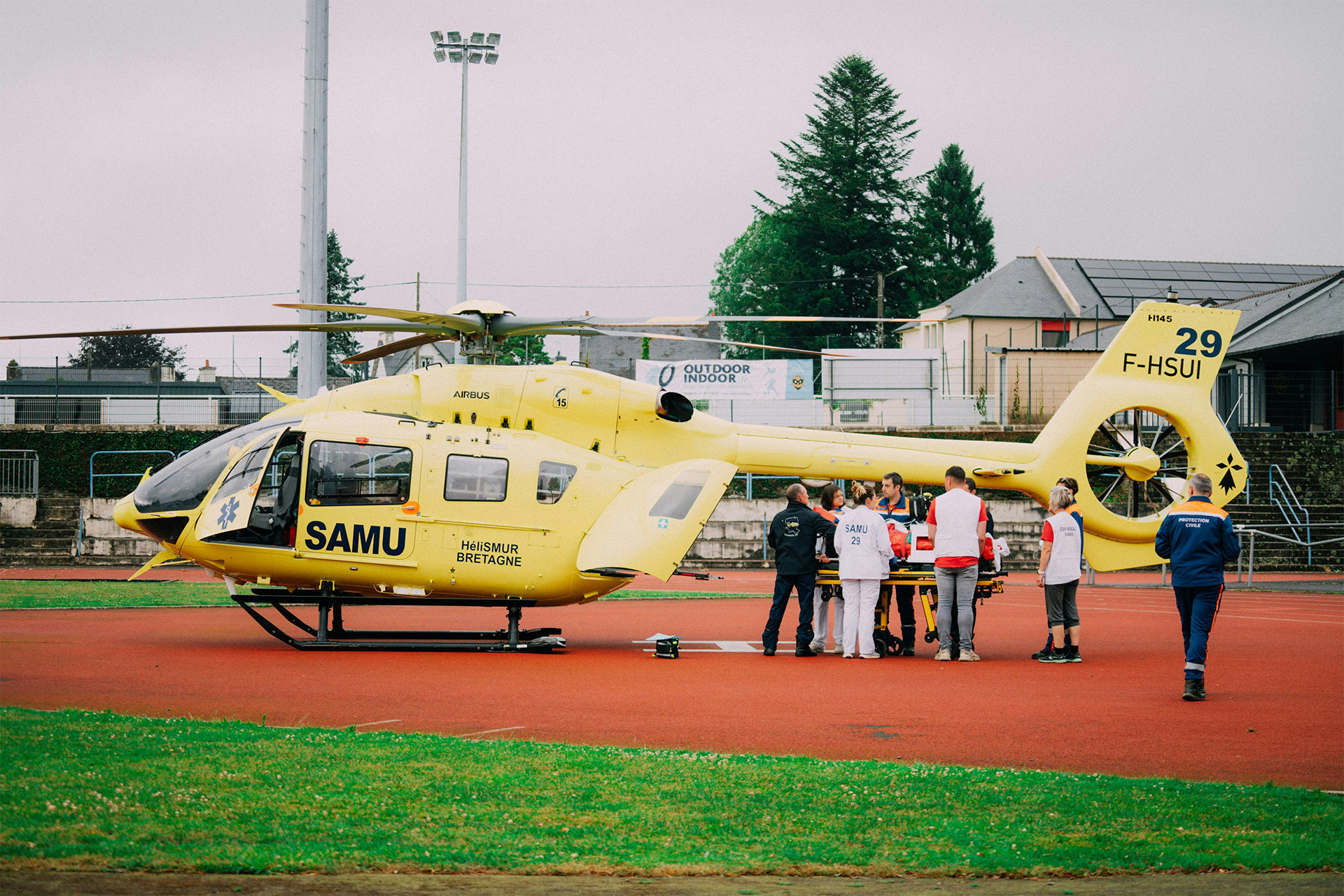
Hubschrauber auf einem Sportplatz mit
Autonomous systems

Energy-efficient flight guidance for rescue helicopter missions

The Challenge

Every day, emergency services around the world are faced with the important task of providing efficient and rapid assistance in critical situations. One component of these missions is air rescue, where it is crucial to provide help to patients as quickly as possible and transport them to appropriate hospitals for further treatment. However, the locations are often in unfamiliar terrain where helicopters cannot land safely. We want to make this challenging landing situation safer and faster for the helicopter crew with the help of technical assistance systems.


How we will help

The ENGEL consortium is developing a complex assistance system that uses suitable sensor technology and artificial intelligence to better detect and understand the helicopter’s environment during flight, approach and landing, thereby enabling the pilot and crew to land even more safely and quickly. We ensure the safe operation of the system through robust software architecture/integration at runtime. In addition, we use data to increase the robustness of AI algorithms responsible for capturing the environment. To design the assistance system, we talk to helicopter pilots, technical crew members and paramedics to better understand their daily work and the challenges they face.

Technologies

Computer Vision Deep Learning Generative AI Self adaptive system ROS2 CI/CD User Research Qualitative Interviews User Journeys Requirements Engineering

User-centered research

To get to know our target group and their day-to-day work better, we conduct qualitative interviews

  • with various air rescue and police pilots
  • with all crew members of a rescue helicopter, including TC HEMS (Technical Crew Member Helicopter Emergency Medical Services) and emergency doctors
  • with people who carry out operations on the ground, such as paramedics

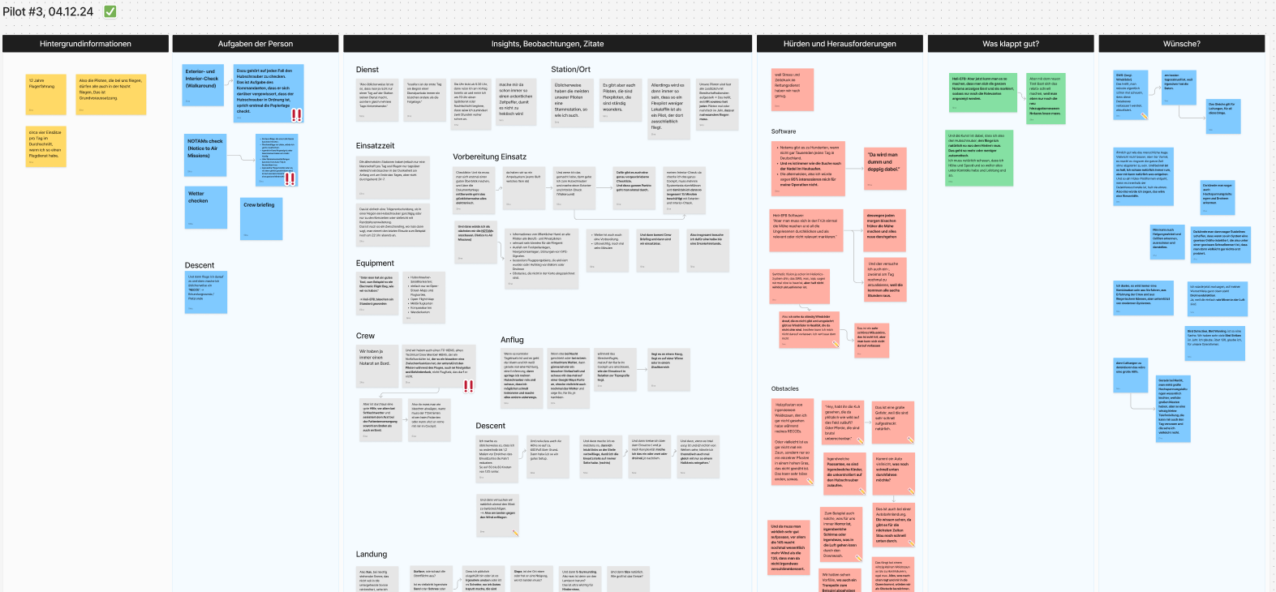
The findings from the target group interviews and research work show the biggest obstacles and challenges faced by the crew in the respective flight phases and make it possible to derive requirements for possible technical solutions.

Darstellung der Auswertung eines Piloteninterviews Interviews nach verschiedenen Kategorien
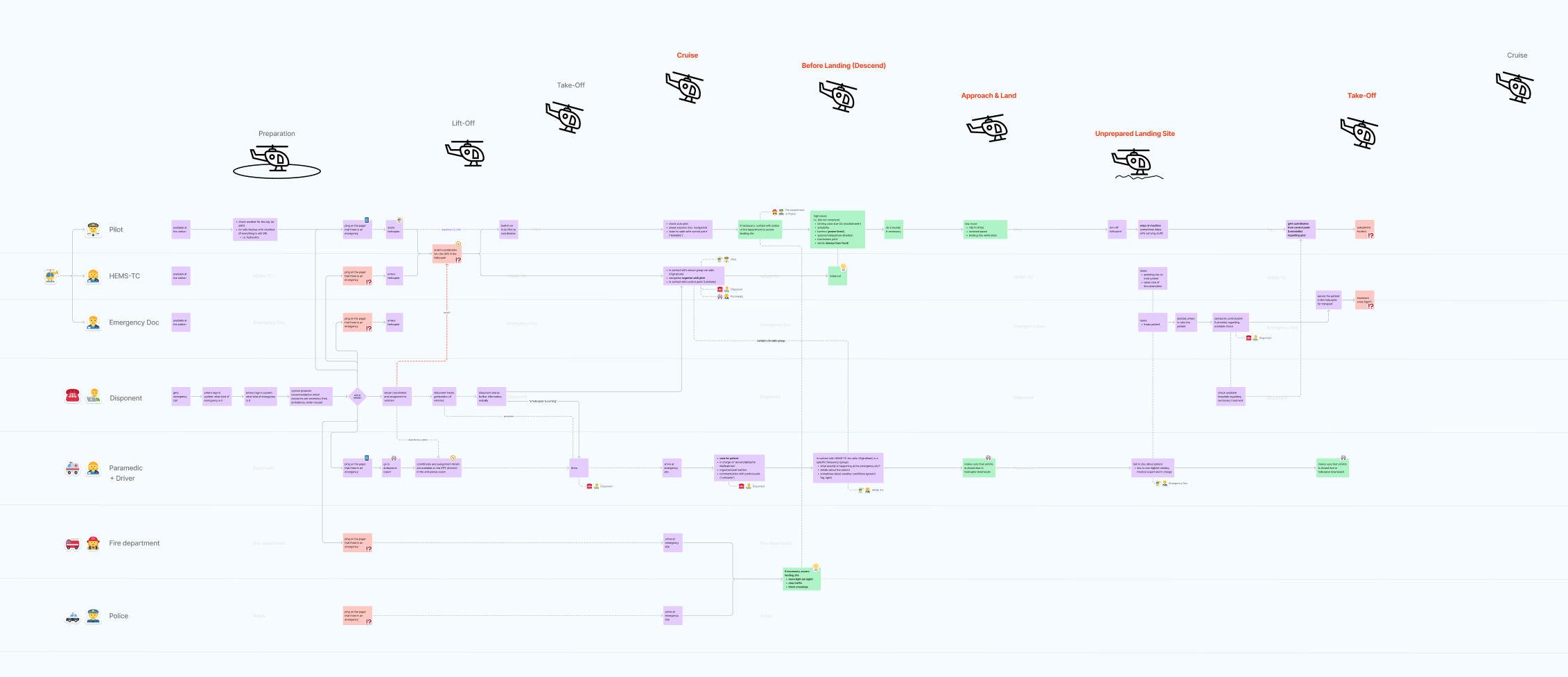
Prozessansicht aller Beteiligten Notfalleinsatz-Personen und deren Kommunikation miteinander

Robust perception

We help develop a more robust perception of the environment by enriching public data sets with synthetically generated realistic data that depicts situations not currently covered by AI algorithms (e.g. weather conditions and rare obstacles). As a result, the AI algorithms in the project are trained on a broader database and deliver reliable results even in rare but dangerous edge cases. This significantly reduces the effort required to collect and annotate real project-specific edge case data.

Bildaufnahme einer Straße mit vielen Autos aus der Vogelperspektive
Grafik der Straßenszene klassifiziert in die verschiedenen sichtbaren Objekte
Bildaufnahme einer Straße mit vielen Autos aus der Vogelperspektive mit künstlich hinzugefügtem Schnee

Software architecture

We develop a software system that integrates all (AI-based) algorithms of the consortium and is also able to monitor and adapt itself during runtime. The adaptations will be executed in order to keep the system as efficient as possible in all different flight phases. Furthermore, it is able to recover itself from possible failures or faults. When monitoring the system, an error analysis is performed at runtime based on the dependencies between software components and constant checking of data quality in the system. This enables us to find and fix the cause of errors, as well as explain to the crew in the helicopter when they can trust the software system.

At ENGEL, we ensure robustness not only at runtime through the self-adaptive system, but also at design time through extensive testing of individual software modules and the overall system with hardware-in-the-loop. To do this, we build an exact replica of the hardware used in the helicopter.

Project participants and funding

Project partners

  • DLR (German Aerospace Center)
  • Fraunhofer FHR
  • Fraunhofer FKIE
  • Fraunhofer IMS
  • Fraunhofer IVI
  • Airbus Helicopters Deutschland GmbH
  • Airbus Defence and Space GmbH
  • BIT Technology Solutions GmbH
  • IMST GmbH
  • Kappa optotronics GmbH
  • Lake Fusion Technologies GmbH
  • X2E GmbH
  • Technische Hochschule Ingolstadt
  • Technische Universität München

Project sponsor

Funding program

Civil aeronautics research program LuFo VI-3

Project management

Aeronautics research at DLR e.V. (PT-LF)

Other projects

Are you interested in a project, a service or do you have any other questions?

Tobias-Huber

Prof. Dr. Tobias Huber

tobias.huber@xitaso.com