From Through-Focus Image Sequences to Real-Time Scene Understanding


The challenge
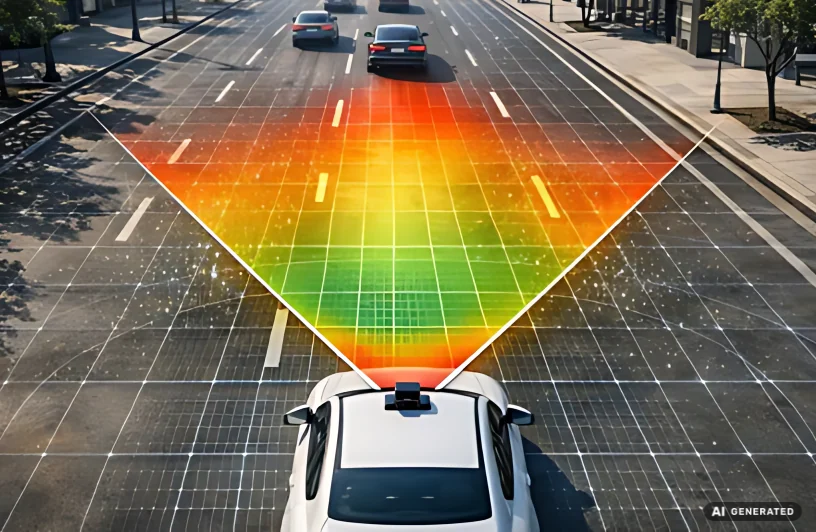
Automotive cameras rely on fixed-focus optics, calibrated to a single depth field. However, driving scenes require object detection across a wide range of distances, from near-field obstacles just centimetres away to far-field vehicles several hundred metres out. Covering this full range with a single fixed focal setting necessitates a trade-off in optical design: near-field sharpness is compromised in favour of far-field resolution, or vice versa. This compromise is further increased at wider field angles, where manufacturing tolerances already introduce measurable degradation in image sharpness.
How we will help
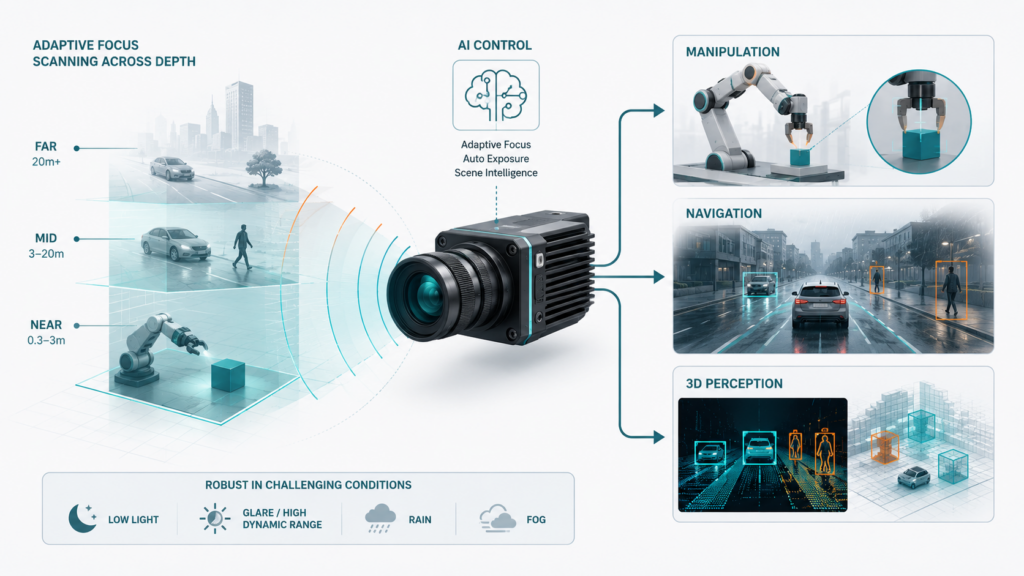
XITASO develops the AI-powered perception software that enables the SasKKIA camera to perceive its environment across the full object-distance range. By processing through-focus image sequences, the software generates fully focused images, estimates object distances, adaptively optimises exposure settings, reconstructs 3D scene geometry, and carries out occupancy prediction and forecasting to improve perception performance under challenging weather and lighting conditions.
Technologies / Methods
Computer Vision
AI-based Perception
Depth Estimation
Adaptive AI Control
Synthetic Data Generation
3D Scene Reconstruction
Occupancy Prediction
World Modelling
Project goal
The goal of this project is to develop a through-focus scanning camera for automotive perception, capable of AI-controlled adaptive focusing across the full object distance range. The system enables sharper detection of both near- and far-field objects in a single mono camera,
extracts distance information without a second lens, and compensates for manufacturing and ageing effects over the vehicle’s lifetime – reducing the optical design and reliability constraints that limit today’s fixed-focus automotive cameras.
Added value
- Improved object detection and tracking across near and far distances.
- Real-time 3D scene understanding from through-focus image sequences.
- More reliable perception in adverse weather and low-light conditions.
- Lower manufacturing and maintenance costs through compensation for optical degradation.
- Higher robustness throughout the vehicle lifecycle.
- Synthetic data generation capabilities for scalable AI training and validation.
- World modelling using semantic occupancy.
Innovation
Existing approaches to depth-of-field limitations, such as liquid lenses in smartphone cameras or through-focus measurement in production testing, address only isolated parts of the problem and are not designed for continuous, AI-controlled operation under automotive conditions.
This project goes beyond the state of the art by:
- Continuously and periodically shifting the image plane during operation, rather than using it only as a one-time production calibration step.
- Using AI to select the sharpest regions from a through-focus image sequence in real time and fuse them into a single, fully focused image.
- Deriving object distance directly from sharpness variation across the sequence, replacing the need for a stereo setup.
- Reconstructing 3D scene geometry from through-focus image sequences to enable richer environmental understanding.
- Modelling the dynamic world with semantic occupancy by using through-focus cameras.
- Integrating depth estimation and image reconstruction into a unified perception pipeline.
- Using AI-based adaptive control to optimise exposure and imaging parameters across through-focus image sequences, extending dynamic range and improving perception performance under challenging lighting and weather conditions.
The result is a mono camera architecture that matches stereo-camera functionality while compensating for manufacturing and ageing effects that conventional fixed-focus optics cannot address.
Project partners and funding
Project partners

Technische Hochschule Ingolstadt
Technische Hochschule Ingolstadt teaches and conducts research in electrical and engineering sciences, computer science, business, sustainability and life sciences, innovatively and at the cutting edge.

AUMOVIO
AUMOVIO is an automotive technology company that develops solutions for safe, connected, software-defined and autonomous vehicles.
Project sponsor
Bavarian State Ministry for Economic Affairs, Regional Development and Energy (StMWi)

Funding program
DIE – BayVFP Funding Line Digitalisation – Electronic Systems
Project management
VDI/VDE Innovation + Technik GmbH
Interested in supporting our research projects?
With research and innovation projects, we explore the potential of tomorrow’s technologies. We are always looking for dedicated colleagues who want to continue along the XITASO path with us and help shape it.
More projects
Are you interested in a project or a service, or do you have any other questions?

Dr. Hannan Ejaz Keen
Tel. +49 821 885 882-281
hannan.keen@xitaso.com